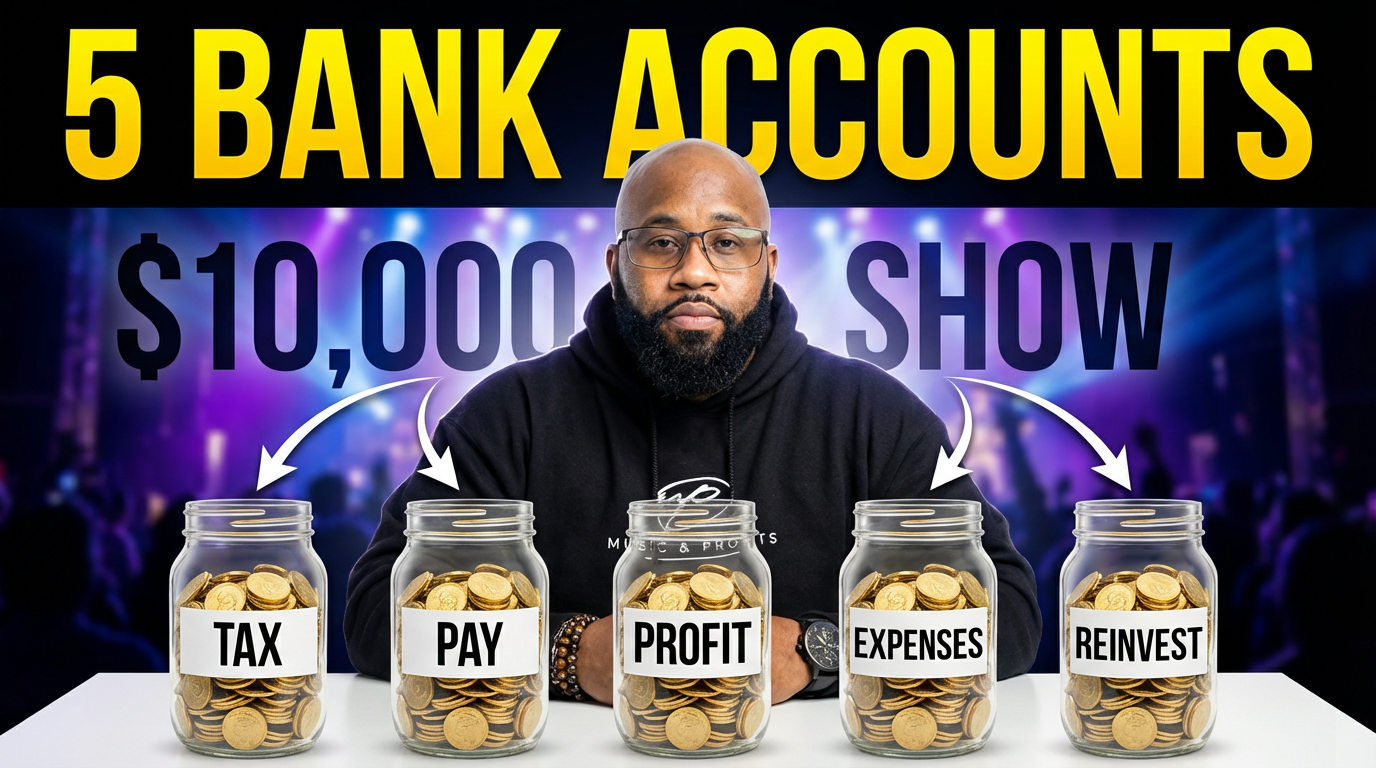
Artist Financial Structure: How to Allocate Music Income the Right Way
Most artists are not broke because they lack talent.
They are broke because they lack financial structure.
If you are generating income from shows, streaming, sync licensing, merchandise, or publishing — but still feel financially stuck — the issue is not revenue. The issue is allocation.
In this breakdown, we are going to walk through how artists should structure their money so they can grow, scale, and build real assets inside the music industry.
Watch the full video explanation below, then use the framework inside this article to implement immediately.
The Real Problem: Artists Mix Everything Together
One of the biggest financial blind spots in the music industry is this:
Artists run their music like a hobby instead of a business.
All income goes into one account.
Expenses come out randomly.
Taxes are an afterthought.
Profit is accidental.
That structure guarantees stress.
If you want longevity, you need separation.
The 4-Account Structure Every Artist Should Use
To operate like a real business, your music income should be divided into four categories:
1. Income Account
This is where all revenue first lands:
-
Streaming revenue
-
Show payments
-
Sync licensing fees
-
Publishing royalties
-
Merchandise sales
No expenses should be paid from this account.
It is a clearing account only.
2. Tax Account
Artists often forget that 1099 income means you are responsible for taxes.
A percentage of every deposit must be moved into a dedicated tax account immediately.
This prevents:
-
End-of-year panic
-
IRS debt
-
Emergency scrambling
Taxes are not optional. Plan for them in advance.
3. Expense Account
This is where business operations are funded:
-
Studio time
-
Marketing
-
Ads
-
Radio promotion
-
Video production
-
Travel
-
Team payments
If it is not in this account, it does not get spent.
This forces discipline and clarity.
4. Profit Account
Most artists skip this completely.
Profit is not what is left over.
Profit is planned.
This account:
-
Builds reserves
-
Funds reinvestment
-
Creates leverage
-
Stabilizes the artist long term
If your music business cannot produce profit, it is not structured correctly.
Why Allocation Creates Stability
Without allocation:
Income feels unpredictable.
With allocation:
Income becomes manageable and strategic.
This structure allows an artist to:
-
Transition from active income to leveraged income
-
Build assets instead of chasing checks
-
Prepare for scale
-
Separate personal lifestyle from business cash flow
That is how you decouple revenue from time.
How This Connects to Royalty Recovery and Publishing
Financial structure only works if revenue is being collected correctly.
That means:
-
PRO registration is accurate
-
Publishing splits are documented
-
SoundExchange is registered
-
MLC registrations are complete
-
ISRC and ISWC data is correct
-
No unclaimed royalties are sitting unpaid
If your back-end is broken, your front-end system cannot function.
At Benjamin Entertainment Group, we focus on:
-
Royalty Recovery Audits
-
Music Publishing Administration
-
Sync Licensing Representation
-
Artist Financial Structure Consulting
-
Booking Representation
Structure + Collection = Scalable Income.
The Transition: From Survival to Strategy
An artist stuck in survival mode:
-
Spends randomly
-
Operates emotionally
-
Reacts to income
An artist operating strategically:
-
Allocates intentionally
-
Builds reserves
-
Funds marketing properly
-
Protects tax exposure
-
Plans growth cycles
The difference is structure.
Next Step
If you want help reviewing your current income structure and royalty flow:
Take the Free Music Business Assessment.
We will identify:
-
Where money is leaking
-
Where registrations are missing
-
Where structure is weak
-
What systems you need immediately
Start here → https://www.musiclegacybuilders.com/assessment
About Benjamin Entertainment Group
Benjamin Entertainment Group is a music licensing, artist management, and publishing company specializing in:
-
Sync placements for film and television
-
Artist booking representation
-
Royalty recovery services
-
Publishing administration
-
Music business systems development
If you are serious about building music assets correctly, structure comes first.